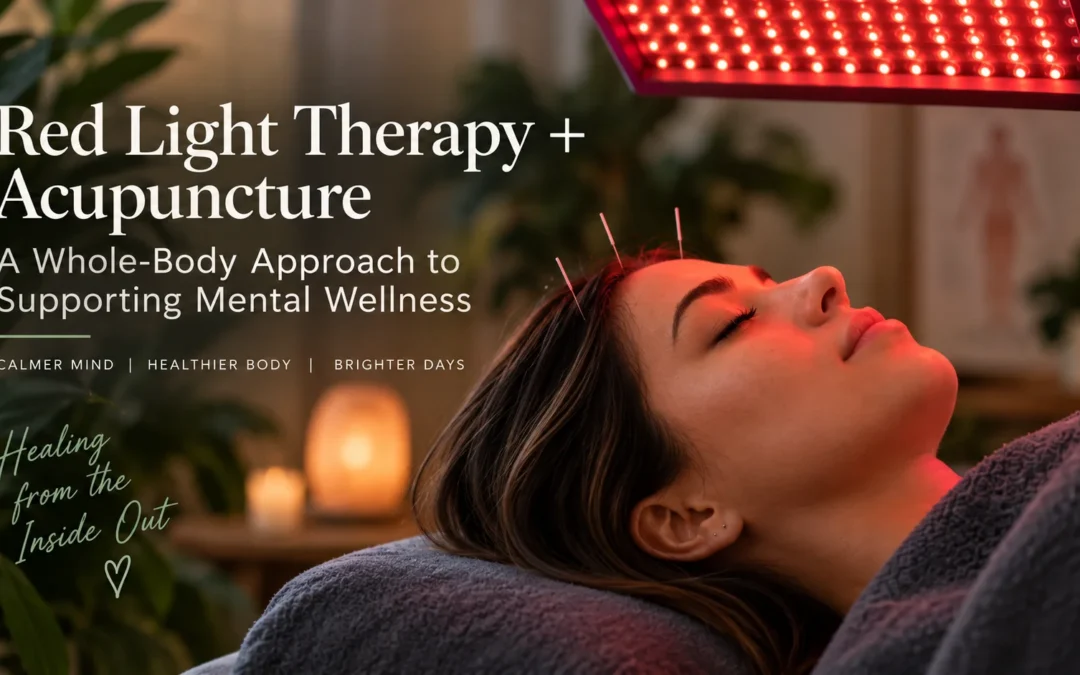
A Whole-Body Approach to Supporting Mental Wellness
Mental health is about more than what happens in the mind. Stress, anxiety, low mood, poor sleep, chronic pain, inflammation, fatigue, and nervous-system dysregulation can all interact—sometimes creating a cycle that leaves a person feeling physically and emotionally depleted.
At Precision Healing & Wellness, we believe in looking at the whole person. Two therapies that can complement one another particularly well are acupuncture and red light therapy, also known as photobiomodulation (PBM).
While neither should replace appropriate medical or mental-health care, emerging research suggests these therapies may provide additional support for relaxation, mood, sleep, stress regulation, and overall well-being.
What Is Red Light Therapy?
Red light therapy uses specific wavelengths of red and near-infrared light to influence biological activity within the body. Unlike ultraviolet light, photobiomodulation does not work by damaging or heating tissue.
One of the primary proposed mechanisms involves the mitochondria—the structures inside our cells responsible for producing much of the energy our bodies use.
Research suggests that red and near-infrared light can influence an enzyme involved in mitochondrial energy production called cytochrome c oxidase. This may affect cellular energy production, circulation, oxidative stress, inflammation, and other biological processes.
Think of it as supporting the body’s cells so they have the resources they need to function efficiently.
What Does Red Light Have to Do With Mental Health?
This is an exciting and still developing area of research.
Photobiomodulation has been investigated for several neurological and psychiatric applications, particularly depressive symptoms. A 2026 systematic review and meta-analysis of 18 photobiomodulation trials found an overall reduction in depressive symptoms, although researchers continue to study which treatment methods, wavelengths, locations, and treatment durations work best.
Researchers are investigating several possible reasons for these effects, including changes involving:
- Mitochondrial energy production
- Blood flow and oxygenation
- Neuroinflammation and oxidative stress
- Neurotransmitter activity
- Neuroplasticity and cellular signaling
These mechanisms are still being studied, and red light therapy should not be presented as a cure for depression or anxiety. Instead, it may be considered one component of a broader wellness or treatment plan when clinically appropriate.
Where Does Acupuncture Come In?
Acupuncture takes a different—but potentially complementary—approach.
From the perspective of Traditional Chinese Medicine, emotional and physical health are interconnected. Stress, worry, grief, anger, poor sleep, digestive disturbances, pain, and fatigue can all be considered when developing an individualized acupuncture treatment.
Modern research has also investigated how acupuncture may influence the autonomic nervous system, stress response, neurotransmitters, endogenous opioids, inflammation, and the hypothalamic-pituitary-adrenal (HPA) axis.
Research into acupuncture for anxiety is encouraging. A 2026 systematic review and meta-analysis involving 20 randomized controlled trials and 1,462 participants found reductions in anxiety symptoms following manual acupuncture, while also noting substantial differences among the studies.
Acupuncture has also been studied for depression, sleep disturbances, and symptoms that frequently accompany emotional stress.
Why Combine Acupuncture and Red Light Therapy?
This is where the two therapies become especially interesting.
Acupuncture and red light therapy work through different pathways, but their goals can overlap.
Acupuncture may help encourage the body to shift away from a constant “fight-or-flight” state and toward a calmer, more regulated state. Red light therapy may simultaneously support cellular and mitochondrial processes associated with energy production, circulation, inflammation, and neurological function.
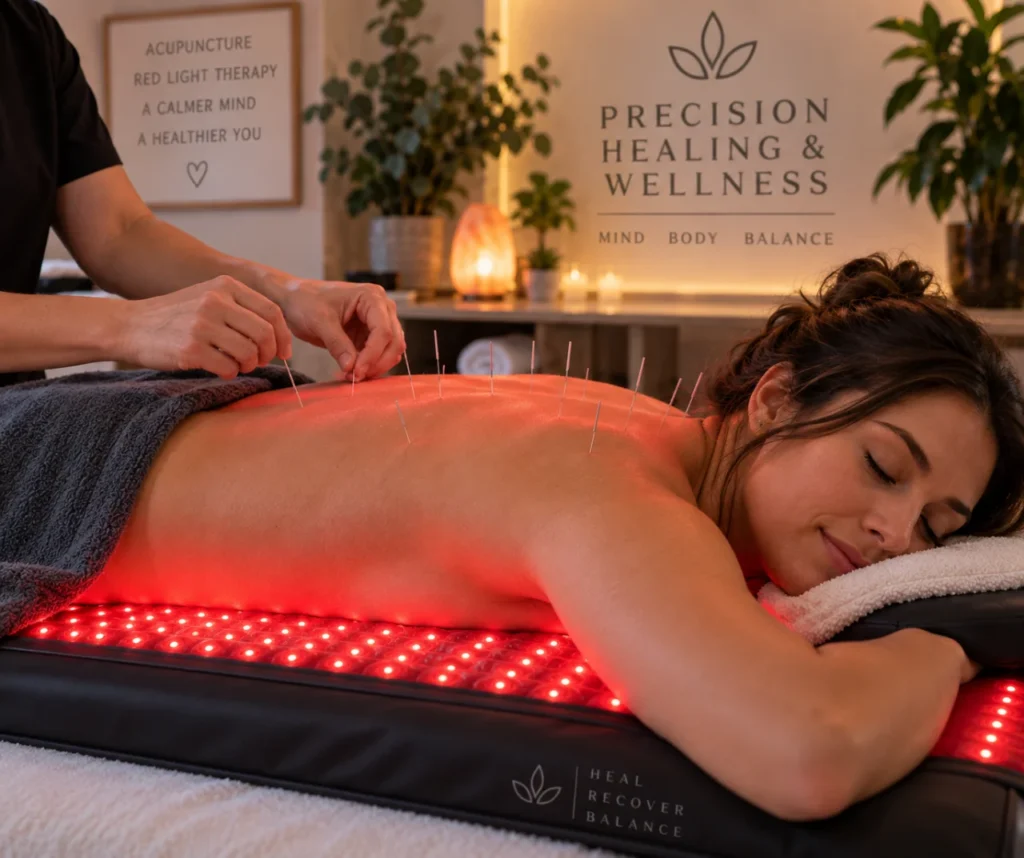
Woman in the process of getting red light therapy.
Together, the goal is not simply to treat an emotion.
The goal is to support the body systems that influence how a person feels physically and emotionally.
For someone experiencing chronic stress, for example, treatment may focus on calming the nervous system, improving sleep, decreasing muscle tension and pain, supporting energy levels, and creating an overall greater sense of relaxation.
When the body isn’t constantly fighting pain, exhaustion, tension, and poor sleep, there may be more room for emotional resilience as well.
The Pain–Stress–Mental Health Connection
Chronic pain and mental health are also closely connected.
Someone living with persistent neck pain, migraines, low back pain, muscle tension, or another chronic condition may experience disrupted sleep, reduced activity, fatigue, frustration, and increased stress.
Likewise, emotional stress can contribute to muscle tension, changes in sleep, headaches, digestive symptoms, and heightened perceptions of discomfort.
This is one reason we don’t always view “physical” and “mental” symptoms as completely separate problems.
Using acupuncture and red light therapy together may allow us to address several pieces of that cycle at the same time—pain, tension, sleep, stress regulation, recovery, and overall wellness.
A Complementary Approach—Not a Replacement
Mental health deserves the same comprehensive care as physical health.
Acupuncture and red light therapy are complementary therapies. They should not replace psychotherapy, prescribed medications, psychiatric care, or other medical treatment when those services are needed.
Instead, they may become another tool in a person’s wellness plan.
At Precision Healing & Wellness, our goal is to meet patients where they are and look beyond a single symptom. By combining traditional therapies such as acupuncture with modern approaches such as photobiomodulation, we can provide patients with additional options for supporting the body, calming the nervous system, managing pain and stress, and improving overall quality of life.
Supporting the Mind Starts With Supporting the Whole Person
Your brain doesn’t exist separately from the rest of your body.
Sleep matters. Pain matters. Stress matters. Movement matters. Nutrition matters. Cellular health matters. And emotional health matters.
Sometimes the most effective wellness strategy isn’t about choosing between traditional and modern medicine—it is about understanding how different approaches can thoughtfully work together.
Interested in learning whether acupuncture and red light therapy may fit into your wellness plan? Contact Precision Healing & Wellness to learn more about our integrative approach to whole-body health.
This information is intended for educational purposes and is not a substitute for medical or mental-health diagnosis or treatment. Individuals experiencing significant depression, anxiety, suicidal thoughts, or other mental-health concerns should seek care from an appropriate licensed healthcare professional.